8
Anatomy
Birds come in a wide range of
sizes from the smallest, the bee
humming bird, to the largest,
the North African ostrich. The
enormous variety of species
can be found in habitats as
diverse as polar regions and
tropical rainforests.
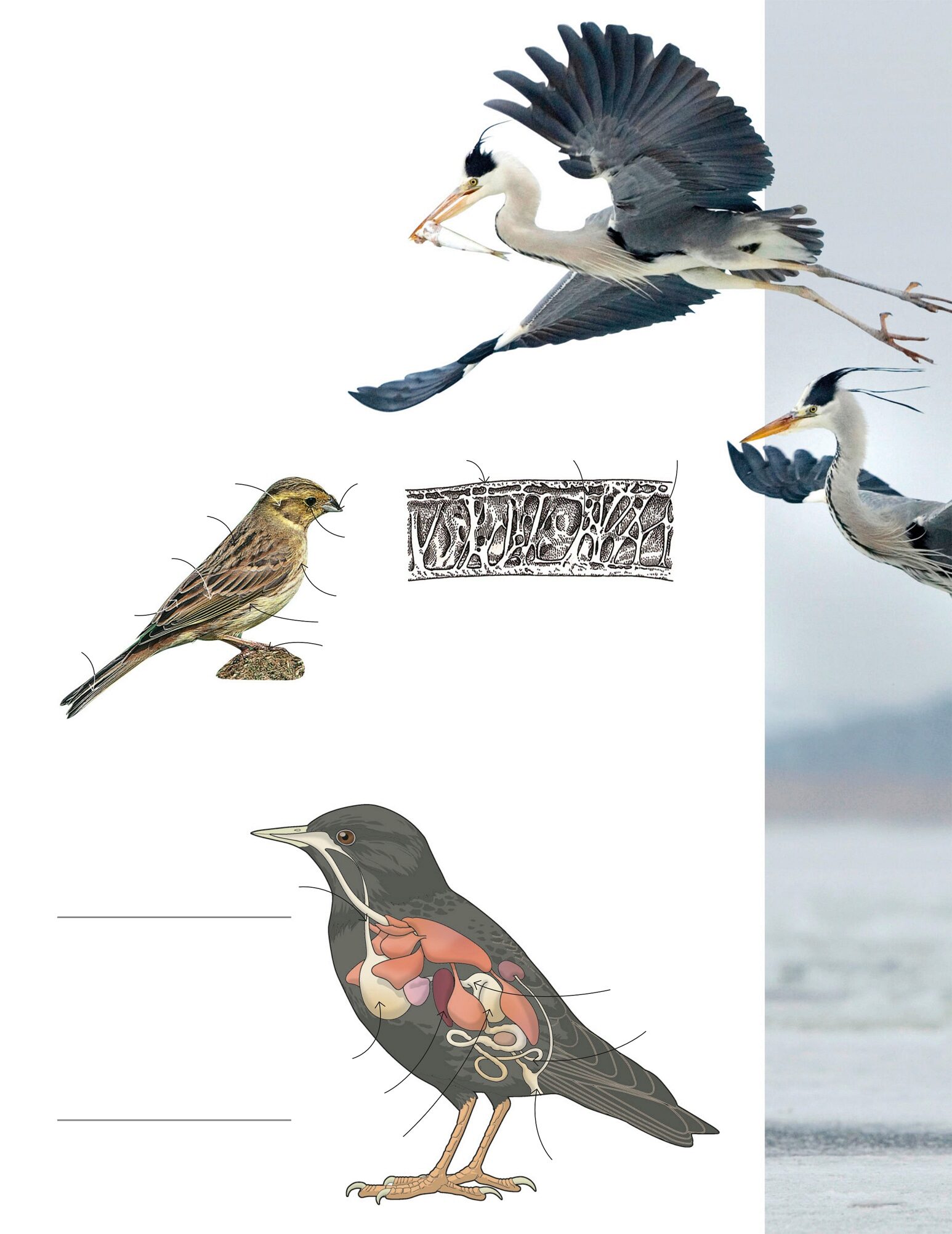
Outer surface
A bird’s entire body, except
its bill and feet, is usually
covered with feathers. Some
birds, such as vultures, have
bare heads and necks.
Ear coverts
Eye
Breast
Flank
Beak
Secondary
flight feathers
Primary
flight
feathers
Tail
Mantle
Toe
External
surface
Reinforcing
strut
Lightweight
interior
Saving weight
Birds need a lightweight skeleton to
be able to fly. Unlike the bones of land
animals, the long bones of flying birds
are hollow and are reinforced with
lightweight internal struts. In many
flightless and diving birds, however,
the bones are solid.
Cross-
section
of a bird’s
bone
Digestive system
As birds have no teeth, their digestive
system has to carry out all the stages
of food breakdown. The lower part of
the stomach, known as the gizzard,
grinds the food into a pulp.
Stomach
Small
intestine
Gizzard
Rectum
Liver
Crop
Gullet
Birds have high
body
temperatures,
which can go
up to 43.5
°C
(110°F)
.